Friday, February 6, 2015

Teen Vogue Headshot

The Bystander Effect: Why You Don't Stand Up When You Should

by Courtney Lindstrand, TEEN VOGUE
Expert tips on how to take a stand when you see someone being bullied.

Bullying is an intimidating, deplorable problem, whether it's playing out in the high school cafeteria or around the internship water cooler. But when you're not the bullied party yourself, it can be tough to know exactly how to handle it -- which is one reason that people often don't step in. Another one? When you see someone being victimized, you tend to think someone else will intervene. Psychologists call this the "bystander effect," and it happens when your brain creates a rationale around why you shouldn't take a stand.
But the truth is that you can't count on anyone else to take the lead: Sometimes it has to be you. And since we know that's not always the easiest thing to do, we chatted with Julie Hertzog, the director of PACER's National Bullying Prevention Center, to get her tips on what to do when you see a super uncool situation unfolding, and how to step in without getting caught in the crossfire.

First off: Recognize that yes, it is your problem.
This is not Switzerland, and you are not a neutral party: When bullying is happening at your school, it's everyone's problem. That kind of behavior was a tolerated part of social culture among teens and kids for a long time, "But now we're realizing that there are really serious not only short term consequences, but long term effects on our society as well," says Hertzog. Since it impacts everybody, it's also each individual's responsibility to stand up and stop it. Consider this: Do you really want your school -- a place where you spend nearly half your day -- to feel unsafe, or unwelcoming? We didn't think so.

Look for subtle ways to reach out to bullying victims.
Sure, it seems sort of shallow, but bystanders are often understandably afraid that speaking up on behalf of someone being bullied can negatively impact their social status (we've got two words for you: Regina George). But even if you don't say something in the moment, you can still help in subtle ways -- like reaching out to the victim directly. It's quick and easy to send a text to someone who just got an earful from your school's biggest jerk. Let them know you're on their side, allow a bud who's being picked on lean on you and stay supportive so they can build the necessary confidence to stop the abuse cycle.

Strike while the iron is cool.
It takes guts to stand up to a bully when they're actively harassing someone else, in no small part because situations like that can get heated fast. But you don't have to jump into the middle of an explosive situation to help, explains Hertzog, noting that you can still be effective while remaining more covert in your efforts to help -- and that there's no need to put yourself in harm's way. In not-so-safe situations, your best bet is to alert an authority figure and then wait until things calm down before becoming involved.

Remember that a safe, supportive environment is your right.
One last thing Hertzog thinks students should know? "Almost every state in our nation has a bullying prevention law that says students have the right to be safe at school." Being personally knowledgeable about these laws and what they entitle you to can help you tip off a victim to their options, or even talk to school officials about how they can take steps toward shutting down a bullying problem in your school (organizations like Hertzog's can help get you started -- head over to the site for more info). The bottom line? There's no reason to be a bullying bystander when you can be part of the solution instead.

Friday, January 30, 2015

David, age 3, waiting to board the bus for preschool.

Inspiration


At age 3, David didn't walk; he scooted. He could sit on his behind and motor those crisscrossed legs across a wooden floor faster than most people could walk. Kids usually wear out the soles of their shoes, but not David – he wore holes in the seat of his pants and on the outside canvas of his high-tops, all the while keeping the triangle pattern on the bottom of his shoes completely intact.

Did I ever worry that he would walk? Sure. Did it ever make me sad? Of course. Most parents want more for their children, and I'm right there with them.
David, running the 200 meter dash.

That was 15 years ago.
Did David finally walk? He did. Before his next birthday, David was up on two legs and soon after that he starting running. In fact, by age 5, he loved speed so much that when I brought him to a store, he would run. He would race around the park. He would run during school – and not just during recess, but out the door of his classroom and through the halls. He constantly raced all over our house. When he ran, he not only smiled – he laughed out loud. His absolute joy and delight saved me from being frustrated that I had to continually chase him down and find him. As a middle-schooler he ran competitively on his school track team and he now runs with his Special Olympic team competing at a local and state level.

I share this story today on my 15th anniversary of working for PACER Center. At the same time that David starting walking, I first walked the halls of our offices. As a disability advocacy organization, we promote hiring parents of children with disabilities, and like so many of my colleagues, I have been inspired by the unique life experience of raising of a child with a disability.
It is my hope that I can continue to look at the world through the same lens as David and to always remember one of the many lessons that he taught me: It may take a while to learn how to walk, but when you do, you might start running – and you should always remember to do it with joy.

Wednesday, January 28, 2015

Borrowed Brains: Q&A with Julie Hertzog, founder of National Bullying Prevention Month


Communities In Schools is doing its part to end bullying, but we’re hardly the only ones. Of all the awareness events out there, National Bullying Prevention Month is probably one of the most successful I’ve ever seen. From traditional media to social media, it’s going to seem like everyone is focused on this one very important issue in October.

Given that kind of traction, you might be surprised to know that National Bullying Prevention Month is less than 10 years old, and it all began with one concerned mother at the PACER Center, a Minnesota nonprofit focused on children with disabilities.

For this edition of “Borrowed Brains,” we spoke with Julie Hertzog, Director of PACER’s National Bullying Prevention Center.

Q: You had a very personal reason for getting involved in this issue. Can you tell me about that?
A: Oftentimes people assume I took up this issue because I was bullied as a kid, but it’s actually much deeper than that. My son David has Down syndrome. When it was time for him to start kindergarten he had a lot of obvious differences from the other kids: He had a feeding tube and a pacemaker and he didn’t talk, he was non-verbal. I knew from my generation that kids with differences were really vulnerable in school, and I just couldn’t let that be his experience. If anyone had the right to be safe at school, it was him and others like him. So David was my passion and my inspiration for getting involved with the PACER Center and the bullying issue in particular.

Q: National Bullying Prevention Month only started in 2006, but it’s really taken on a life of its own, hasn’t it? Tell me about the growth you’ve seen.
A: PACER Center has been around since the 1970s, when the IDEA act gave children with disabilities the right to attend school. PACER was founded to help parents understand their rights and get the best education for their children.

Our connection to bullying started around 2000 when we noticed more parents were contacting us about bullying situations in school. At that time, bullying was considered a natural part of growing up. We said, “No, that’s not right. All kids have the right to be safe.” That’s when we founded the National Bullying Prevention Center with the belief that you can change behavior by changing the culture. And you change the culture by raising awareness, starting conversations, and providing education.

A few years later we looked around and realized there weren’t any national awareness events going on, so our board encouraged us to design a week. The first National Bullying Prevention Week was launched back in October of 2006. We chose October because we wanted to talk about the bullying issue early in the year, but after things had settled down from back-to-school season. From the start had great national partners, including the National PTA and the National Education Association. They really helped us push things forward, and by 2010 there was such a demand for these conversations that we evolved it to a full month.

I think one reason this has caught on is that we try to be thoughtful and positive in what we do. We work with schools and parents and kids, encouraging everyone to come together to prevent bullying. We want students to take ownership of this issue, and we’ve just redesigned two of our websites, Kids Against Bullying and Teens Against Bullying to speak even more directly to the ones who are most affected by this.

Bullying is also an issue that touches almost everyone in some way. Maybe they experienced it themselves, or maybe their children, or maybe they witnessed it and wanted to help. National Bullying Prevention Month provides that opportunity for anyone to get involved in the conversation. We engage the broader community because the No. 1 question we get is, “How can I help?” We try to provide accessible, inexpensive resources for anyone who wants to get involved, whether it’s wearing orange on Unity Day [Oct. 21], signing a digital petition, or joining one of our Run Walk Roll Against Bullying events across the country.

Q: You developed a peer advocacy approach that enlists student volunteers to act as a voice for those who are different. Is it only the “popular kids” who become advocates? I’m wondering if something like this might provide some marginalized, at-risk kids with a sense of purpose for staying in school.
A: I love this question! Let me go back to my personal story: When David was ready to enter middle school, we realized that the dynamic was going to change. He’d be changing classes, so he wouldn’t be with the same teacher in the same, safe classroom all the time. David was still non-verbal, but he had made a lot of friends, and I saw that those friends could become his eyes and ears and voice throughout the day in a way that no adult ever could.

We decided to train four kids who liked David to help and advocate and report any problems to a teacher. Ironically, only one of those was what I would call a leader or a “popular kid.” The others were just good kids who wanted to do the right thing. Anyway, they started talking to their friends about what they were doing, and within a month it grew from four kids to 16 kids, just by word of mouth. By the end of 6th grade, 51 kids asked to be involved; they weren’t recruited, they came to us.
We started this effort for kids like David with obvious differences, but we found that some of the advocates had differences of their own that were more subtle – maybe ADHD or dyslexia or some other learning or developmental disability. They created an amazing group dynamic, reinforcing support for each other. When the year was over, we did exit surveys and 100% of the advocates said they felt like they helped to improve someone else’s life, and 100% wanted to do it again next year. So being an advocate for others gave them a sense of purpose that went beyond the normal concerns of the school day.

Q: Finally, what’s the role for adults in all of this? In thousands of schools nationwide, we have trained Site Coordinators who form personal relationships with at-risk students. If they could do or say one thing to help prevent bullying, what would it be?
Great question and it’s a challenge to pick just one thing. My instinct though is to share that it’s so important that for any student who has ever felt vulnerable, or isolated, that they know that they are not alone. They need to know that someone cares, that there are people who will help them. To be the person in a role in which you literally change a young person’s life by letting them know they are supported is really powerful.

Monday, August 25, 2014

BULLIES and BYSTANDERS: WHAT EXPERTS SAY

Bullies and Bystanders What Experts Say


SHOUT OUT

Special thanks to Be Smart. Be Well. for Detective Hollendoner of the Chicago Police Department and me in their important new video Bullying: Stand Up, Don’t Stand By.

Julie Hertzog

Julie Hertzog
Director, PACER’s National Bullying Prevention Center

Julie Hertzog is a nationally recognized leader on bullying prevention. As director of the National Bullying Prevention Center, she has led the development of a variety of curricula and resources, including creating content for the Center’s innovative websites, PACERKidsAgainstBullying.org and PACERTeensAgainstBullying.org, which were designed to engage, educate and inspire students. In 2012, she was appointed as a member and co-chair of Minnesota’s Governor’s Task Force on the Prevention of School Bullying; and in 2013, she was an external reviewer for “Bullying Surveillance Among Youths: Uniform Definitions for Public Health and Recommended Data Elements,” developed by the National Center for Injury Prevention and Control, Centers for Disease Control and Prevention and the United States Department of Education.

Charles F. Hollendoner

Det. Charles F. Hollendoner
Chicago Police Department

Detective Charles F. Hollendoner is a 22-year veteran of the Chicago Police Department. He has been assigned for the past 13 years as a Detective in the Special Investigations Unit. He is also a member of Cook County’s Internet Crimes Against Children Task Force and the Chicago Police Department’s Internet Child Exploitation Team. He has conducted numerous Internet Safety Presentations to elementary and high schools students, as well as community leaders and parents throughout Chicago.
The viewpoints expressed here by Det. Hollendoner are his own and not those of the Chicago Police Department.


Friday, June 27, 2014

INSPIRED BY DOWN SYNDROME


I love this story, posted in TELESCOPE magazine, because it shows that some of our most powerful lessons are those that we learn from our children.

blog_julie hertzog

By Heather Ronaldson
 
Before Julie Hertzog’s son, David, turned three years old, he had already undergone three open heart surgeries, a tracheotomy and required a breathing ventilator. David was born with Down syndrome.
 “There was no doubt about it: My son wasn’t like his peers,” said Hertzog in a self-authored article online in 2010.
 
As David was preparing to enter kindergarten, Hertzog feared that David would become “a poster child for children expected to be the targets of bullying,” she said, as David was nonverbal, had delayed cognitive abilities and received his nutrition from a feeding tube.
Instead of sitting on the sidelines and watching, Hertzog decided to do something about it. She became David’s advocate: talking with students, faculty and staff to educate them about Down syndrome.
 
“I remembered how kids with disabilities were treated in my generation, so I didn’t want that to be his experience,” said Hertzog.
 
Hertzog joined the PACER Center, a resource for children and young adults with disabilities and their families in 2000 and soon after headed its National Center for Bullying Prevention in Minnesota. Through it, Hertzog has created replicable peer advocacy programs for students across the country in the same way peers first helped David.
 
“The concept sounds simple, but because my son can’t tell me what happens during the day, I depend heavily on these peers to act as his voice. Now, what started as four kids in sixth grade has evolved to a school-wide project with more than 40 students volunteering to become peer advocates so they can help David and other students who are different,” said Hertzog in her article.
 
“It had amazing outcomes,” said Hertzog.
 
The peer advocacy model is now available online so other schools can create programs in their cities.
David is 17 now. “He is always at the core of my thoughts when I’m thinking about anything,” said Hertzog.
 
Hertzog has developed classroom toolkits, curricula and other resources through the National Bullying Prevention Center. She also created nationally recognized events such as PACER’S National Bullying Prevention Month, Unity Day and Rock, Walk, Roll Against Bullying, in October.
On Unity Day, people are encouraged to wear the color orange to show solidarity, said Hertzog. “That event has continued to grow and evolve and we expect it to be bigger than ever.”
 
Measuring the success of anti-bullying programs isn’t easy, as “we are looking to change the social paradigm,” said Hertzog.
 
But there are positive outcomes.“People are starting to understand the topic better than before. We’re starting to see real change happening. That to me is so encouraging.”
 
Hertzog recalled one year when Blue Earth, Minnesota was temporarily referred to as “Orange Earth” in honor of bullying prevention month. General Mills even dressed its 55-foot Jolly Green Giant statue, which stands in Blue Earth, in orange.
 
Hertzog said one student said, “I wish the Green Giant would wear orange year-round so it’s not an issue today, but an issue year-round.”
 
While her work can be overwhelming, Hertzog said that in those moments, she looks through the lens of her son.“I look at myself first and foremost as a mom and I think that my son David has taught me to see human dignity for all regardless of who you are—that you have the right to go to school to feel safe, valued and respected. He’s been such an important piece of always keeping me grounded,” said Hertzog.

Friday, June 6, 2014

This article posted as a blog to the StopBullying.gov website provides insight into bullying and suicide.

-------------------------------

Bullying and Suicide: What’s the Connection?

Sad teen boy is seated with a backpack.

In the past decade, headlines reporting the tragic stories of a young person’s suicide death linked in some way to bullying have become regrettably common. There is so much pain and suffering associated with each of these events, affecting individuals, families, communities and our society as a whole. There is an increasing national outcry to “do something” about the problem of bullying and suicide.

The Centers for Disease Control and Prevention (CDC) and other violence prevention partners are conducting research to learn more about the relationship between these two serious public health problems with the goal of using what we have learned to save lives and prevent future suffering. One example of this work is in September 2010, the CDC brought together a panel of experts who presented research focusing on this complex relationship between youth involvement in bullying (youth who bully, youth who are bullied, and those who bully and are bullied) and suicide-related behaviors (attempts, deaths, and risk factors associated with suicide such as depression). These experts published their results in a recently released special issue of the Journal of Adolescent Health. The eight articles included in the special issue help to clarify the complicated issues surrounding bullying and suicide among youth.

This is what we DON’T know about bullying and suicide:
  • We don’t know if bullying directly causes suicide.  We know that most kids who are involved in bullying do NOT engage in suicide-related behavior.  It is correct to say that involvement in bullying, along with other risk factors, can increase the chance that a young person will engage in suicide-related behaviors.
Here is what we DO know:
  • We know that bullying behavior and suicide-related behavior are related. This means youth who report any involvement with bullying behavior are more likely to report suicide-related behavior than youth who do not report any involvement with bullying behavior.
  • Discussing bullying as directly caused by or as the only cause of suicide is not helpful and is potentially harmful because…
    1. It encourages sensationalized reporting, contradicts the Recommendations for Reporting on Suicide  and potentially encouraging copycat behavior.
    2. It focuses on blaming and punishing and does not give critical attention to the necessary support and treatment youth who are involved with bullying need.
    3. It takes attention away from other important risk factors for suicidal behavior that need to be addressed (e.g., mental illnesses, coping with disease/disability, family dysfunction, etc.).
    4. It perpetuates the false notion that suicide is a natural response to being bullied, which has the dangerous potential to normalize the response and thus create “suicide contagion” among youth.
So what can we do with this information? There are public health strategies that can be applied to the prevention of bullying and suicide. For example, increasing connectedness among youth and parents, other adults, and teachers may decrease bullying and suicide behaviors.
In 2012, the Federal Partners in Bullying Prevention worked with the Suicide Prevention Resource Center to conduct a webinar on bullying and suicide. For more information, tools and resources, please visit Stopbullying.gov’s Who Is At Risk section and Media Guidelines for Bullying Prevention.

Friday, April 11, 2014

Safe and Supportive Minnesota Schools Act — Signed Into Law April 9, 2014

 
It was very moving to be a part of Governor Dayton’s historic signing of the “Safe and Supportive Minnesota Schools Act", which took Minnesota from a 37 word statute to one of the most comprehensive laws in the nation.
 
This law is so important—as all students deserve to go to school and learn in an environment in which they feel safe, valued and supported. Governor Dayton summed up student rights eloquently during his speech “Nobody in this state or nation should have to feel bad about themselves for being who they are.” And 11-year-old Jake Ross stole the show with his moving words about his own experiences being bullied and his enthusiasm for the passage of the act when he voiced the thoughts of many gathered on the steps when he said, “I’ve been waiting for this day for a long time.”


Friday, March 28, 2014

The Short Bus Stops at My House


This is an essay written by my oldest daughter. I love it for many reasons—the first is that I am proud of the person my daughter is becoming, the second is that it's honest and insightful and the third is that it is a testimony of unconditional love and acceptance.

---------------------------------------------------------------------

"The Short Bus Stops at my House"
By Laura Hertzog (age 18) for her brother, David (age 17)

It’s funny how the length of the bus you ride has the ability to define you as a person. Personally, I rode the regular sized bus, the one the “normal” students rode to school. However, there was another bus that happened to stop at my house every weekday morning. The ...short bus, "the retard racer", the bus that was transportation for my brother. Yes, my brother rode the short bus and will forever be the root of some kid’s immature joke. Or even worse the root of some adult’s joke. My brother is defined by his transportation of getting to school. They look past his ability to smile while making his bed every morning, or him surviving five open heart surgeries before the age of five, or his ability to say “Luve you all.” It’s all looked past because of society’s standards of perfection.

Society has its stereotype of perfection for high school students. And let me tell you, the qualities of Down syndrome do not match our standards of perfection. Slurred speech, trouble writing, slowed motor skills, noticeable scars are the blunt indicators of the imperfections my brother has that society tells him and our family. His cognitive abilities will never meet education standards. I can remember the day my mom told me my brother did not meet the minimum of the bottom two percent on a standardized test. The anger stays with me today. The test didn’t show how far he has progressed from his starting point. It simply just related him to his other peers. He will always need to be in special education, he will always need a para helping him through the school day.

This may be how my brother is viewed in society but I can tell you this is long far how I view my brother. David may be 17 months younger than me but I view him as a role model, someone to impersonate. As I wake up in the morning, worried about if I will have enough time to put on make-up, and what the cafeteria is serving for breakfast, and how hard practice is going to be, and am I going to have someone to sit with at dinner tonight, and how I’m going to have to read 60 pages, and make sure I keep up on social media; not one of those things come as a concern to David. There is something beautiful about his innocence. His worries in life are so minor compared to the average person. His worries consist of grabbing his two favorite toys to bring with to school, making sure he brushes his teeth in the morning, and making sure the channel is tuned into the evening news at six. It’s humbling to observe

I didn’t ask for my brother to have Down syndrome, nor did my parents, nor did my brother. However, I know we can all agree David is the reason our family is so strong. It’s the reason my mother fights for to uphold human dignity every day. It’s the reason for my father’s compassion. It’s my reason for counting my blessings at night. It’s the reason for my sister’s generosity. Down syndrome may have put some road blocks in the way, may have caused some eccentric looks from strangers in the crowd, but ultimately Down syndrome has brought my family joy and has redefined perfection for each one of us.

And the short bus stopping at my house was the greatest blessing.

Friday, March 7, 2014

 
--------------------------------------------------------------------

Published Online In Education Week: December 10, 2013
Published in Print: December 11, 2013, as The Best Antidote to Bullying? Community-Building
Commentary

The Best Antidote to Bullying? Community-Building

Bullying doesn't wound students; it pours salt on a pre-existing injury, causing it to hurt even more. Most students who are bullied have already been hurt. They are wounded by exclusion when they find themselves without friends or allies. They are wounded when they fail in school, or when they don't gain the approval of their peers or, all too often, their teachers. They are wounded when they don't get the help they need. And they are wounded when they feel they have no place to go, or no one to talk to.

Preventing students from being hurt in the first place is the most effective way to thwart, as well as dramatically reduce, bullying. When students are members of a strong community, they feel accepted and supported, not isolated and excluded. They can trust that there will be someone to help them if they are in need. A school community is a place where people value each other and have a sense of responsibility for helping everyone feel safe and protected. Not all schools are communities, however.

Some schools focus solely on individual achievement. True, students need to be concerned about their own grades, about following the rules, and respecting their teachers; they should also be challenged, though, to care about the safety and the success of others. Students can learn how to support and defend their peers—and not just those with whom they share obvious similarities. Students should learn how to care about and defend those who might be different from them. As schools expect students to meet high academic standards, so can they expect students to meet high moral standards.

When schools lack a strong sense of community, the result is an environment in which students gravitate toward either "the winners" or "the losers." Students quickly learn the difference, as well as the importance of associating with the popular kids.
 
"When students are members of a strong community, they feel accepted and supported, not isolated and excluded."
Students who bully often seek to improve their social standing and demonstrate their social prowess to their peers. They carefully select as their targets the most unpopular students, those without friends or allies, in an attempt to earn a place in their desired social group.
Students who witness bullying often refrain from standing up for the victims, not from a lack of empathy but from the fear of being associated with the targeted student. Unfortunately, their reluctance to intervene or report bullying gives tacit approval to the student who bullies, giving that student license to continue. And the problem grows—other students are tempted to bully as a way to move up the social ladder.

The problem is compounded because students who bully strike beyond the radar of adult supervision. This is a subtle pattern almost impossible to detect by even the most caring and competent educator. Under these conditions, bullying can persist in even the most successful and high-achieving schools. The methods that successfully control other inappropriate school behaviors don't work when it comes to bullying. In fact, educators who are effective classroom managers are often unable to control the bullying that can happen in plain sight.

For educators to be effective at bullying prevention and reduction, they must shift their attention from only disciplining students who bully to empowering students who could be in a position to stop it.

When bystanders are given the skills, the confidence, and the courage to intervene or report abusive behavior, the student who bullies is disempowered. When the number of students who defend and protect their vulnerable peers grows, the school's social norms shift from the unspoken acceptance of bullying to one where bullying is not tolerated.
Building a strong school culture in which this behavior violates social norms is a challenge—often, even more difficult than implementing policies or programs. But it is also a necessary goal for any school. It requires a commitment for changing how individuals see and treat each other. It requires the nurturing and strengthening of the school's social connections. When bullying prevention is reframed as community-building, it moves from a problem-solving scenario to an opportunity for improving the learning environment for everyone.

Schools can begin this healing and healthful process by asking staff members and students to consider and discuss the differences between a group of individuals and a community. Students should explore what their responsibilities and obligations to their peers are. Staff and students should talk about the existing challenges and the barriers to helping others. From these discussions, the school community can develop specific strategies for what to do and say when anyone witnesses an act of bullying. Students can and should play a role in planning how to make their school a better place, to insure that everyone is treated with respect.

When schools encourage these discussions, they send a message to students that looking out for others is one of their core values. Educating students to take ownership and responsibility for their learning environment is the best preparation for becoming good citizens.

As schools become stronger communities, they provide students with the protection and the platform they need for continuous growth and learning. This should be the goal of bullying prevention and for how we educate all students.

Thursday, December 5, 2013

Orange, Orange and More Orange!


Special thanks to the third graders at Lafayette Regional School in Franconia, New Hampshire who were inspired by Unity Day! The following blog is authored by Brielle and Julia and the link can be found at the KELLEYKIDS BLOG

-------------------------------------------------------

Have you heard of Unity day? You’re probably wondering how we know about Unity Day. We learned about it in a Time for Kids.  Well, Time for Kids is a little magazine that  we  got the idea from.

Unity day is a day that Julie Hertzog  made up. She wanted any kid that was being bullied to feel good. And that is hard to believe.  But it is a good thing, a very good thing.  Because when you get bullied you feel sad.
Introduction   by Lily and Finn.

PLANNING!

     After the third grade at Lafayette Regional School read the article from TFK we decided to spread the word!

We wanted the whole school to participate.   So we had to plan a lot of stuff. On Friday we planned with Mrs. Koehler and Mrs. Kelley.  On Monday we asked permission of Mr. Johnk and he said, “Go for it!”   During art class we got Mrs. Overhoff, Mrs. Marks, Mrs. Albrecht  and Miss St. Jean to help.  All of us worked on a Unity Day Project to make a poster to spread the word!!   We even asked Mrs. Butterfield to make an announcement about Unity Day at the end of the day.
By: Sam and Liam

About the Chains and How We Made Them

     We also started making a chain out of orange strips of paper with our ideas how you can stop bullying. The basic idea was for the whole school to make a gigantic chain that goes through the building. What the chain was supposed to do is it spreads all of your ideas throughout the world to help stop bullying. Someday we hope that our (and your) ideas will fill up the whole world. We wrote things down like,” If I saw bullying I would tell a teacher,” and “If you are a bystander, get help or be help.” etc. We also made a movie of our posters and us reading our ideas on our strips of paper with a message at the end.  Remember, anyone can stop bullying.
By: Brody and Yuto

Another Thing We Did is We Wore Orange…                       
   
Orange Kapow!!!!

     We wore orange on October 9th 2013 to help stop bullying. Unity Day was a day to wear orange. Julie created Pacer’s National  Bullying  Prevention center.  Julie says “All kids have the right to feel safe at school and in their community.” We found all this information in a Time For Kids called "Forbidden Foods". There are 3 different articles. We looked at one called "A Powerful Way to Stop Bullies". Stand up for your friends if you see someone getting bullied. Hope you join in next Unity Day on October 9th.   
  
See ya!                                                                                                                                                                 By Brielle and Julia

Friday, November 22, 2013


Question: What happens when a Minnesota non-profit,
a Minnesota business and a Minnesota community
unite to prevent bullying?
Answer: An giant iconic statue goes orange!
 
 
------------------------------------------------------------------
 
        That’s what happened in the community of Blue Earth, Minnesota on Unity Day, October 9, 2013, when the Green Giant statue sported an orange toga to show support of PACER’s Unity Day. Representatives from PACER’s National Bullying Prevention Center, Green Giant, and Blue Earth spoke at the event, in which Blue Earth was proclaimed “Orange Earth” in recognition of Unity Day.
 
         In my speech, I spoke about a memory from 3rd grade in which we were given the art assignment to draw our favorite character and I drew the Green Giant. This was almost four decades ago, but I vividly remember it as I can recall how even then the Green Giant stood for goodness and strength. I shared that in the coming days, weeks, and even years from now, that I believe when people see images of the Green Giant wearing the orange toga or when they think back to the day, that they will reflect on their own “inner giant”. That they will know that this is a moment of tremendous symbolism, representing the uniting of individuals to show that people care passionately about keeping students safe.
 
------------------------------------------------------------------
 
 
Want to read more? Visit the online article by Chuck Hunt, Faribault County Register Editor.
 
October 13, 2013 by Chuck Hunt - Register Editor (chunt@faribaultcountyregister.com)
The Green Giant turned orange, the mayor declared the city's name be changed to Orange Earth and students from Blue Earth Area showed up in anti-bullying orange T-shirts. It was all part of a media event called Unity Day held last Wednesday morning at Blue Earth's Giant Park.
 
Co-sponsored by General Mills and their Green Giant Company, and PACER (a Minneapolis based national Bullying Prevention Center), the hope was to create a buzz in media across the country in support of October being Bullying Prevention Month. Read more>>>


Friday, November 15, 2013


"We Will Be Giant" takes big steps to end bullying

An article featuring my son, David, which illustrates the power of peer to peer intervention. Special thanks to the author, Deepa Shankran, and our amazing partners; Green Giant, Free the Children and We Day!
Posted to the WE DAY section of the STAR TRIBUNE on October 6, 2013

Tuesday, October 15, 2013

My daughter Grace was interviewed for an article that appeared in TIME For Kids online at http://www.timeforkids.com/news/united-front/105091 and in print.

Grace, like so many of her peers, knows the importance of standing together, so that no one stands alone, but then again, as her mother, I am biased :) 

----------------------------------- 

A United Front

On October 9, kids will wear orange to show their support for Unity Day and to stand up against bullying.
 
September 27, 2013
 
 
Grace Hertzog knows what she is wearing on October 9. "Tons of orange," the sixth grader from Watertown, Minnesota, told TFK. "Orange glasses, shoes, beads, a skirt, and an orange Unity Day T-shirt."
 
Unity Day is an annual event that Grace's mom, Julie, helped start. She is the director of Pacer's National Bullying Prevention Center. People can take part in Unity Day, which this year is on October 9, simply by wearing the color orange. They can also perform a group dance, make bullying-prevention paper chains, and sell Choose Orange bracelets that will help Pacer pay for future programs.
 
The goal of these activities is to show support for kids who are bullied. A study by the Youth Voice Project, at Penn State University, found that one in four students is bullied emotionally, by being left out, teased, or called names regularly, and about one in 10 is bullied physically, which includes pushing and hitting.
 
"When awareness is raised around bullying, students no longer feel alone, and they learn they have options," explains Julie Hertzog. "All kids have the right to feel safe at school and in their community."
 
Unity Day is one of several Pacer events planned for October, which is known as National Bullying Prevention Month. Details about the activities are available at pacer.org/bullying.

Grace plans to continue her anti-bullying efforts throughout the year by being an upstander. That is a person who reports bullying to an adult and is kind to anyone who is bullied. How will you help make sure bullying is not an issue at your school this year?

To access the digital edition of TIME For Kids, go to timeforkids.com/digital.

Friday, October 4, 2013


Over the past several months PACER Center has been partnering with the General Mills brand Green Giant to develop The We Will Generation which will be available to schools this year. In working with us on this project the Green Giant team also wanted to create a program for parents to help them find a way to talk to their children about bullying. This program is called “Raise A Giant” and comes to life through letters written by parents to their children. I’m asking you to help bring this movement to life by writing a letter for the Raise A Giant movement and then sharing it with others to inspire them to write one as well. The letter that I wrote to my 17-year-old son David is posted on-line and copied below.
 
I hope to see your letter on www.raiseagiant.com this October!

----------------------------------------------------------------

Dear David,

Long before you or your sisters were born, I had dreams of what I wanted for my children. My dreams for all of you were really quite simple – no five-bedroom house by the lake complete with a pontoon and matching jet skis. (Don’t get me wrong, if you do have a house like that I will definitely come to visit!) No, my dreams were more about who you would become as individuals and what your footprint on the planet would be.

There were two things I wanted for you: First, that you would be good citizens of the world, and second, that you would be happy. I know what you’re thinking. You probably have that big grin on your face, the one you get when things don’t make much sense. “Good citizens of the world? What does that even mean?” Well, David, for me it means that you will give back to the world more than you take. It means that your actions will have a positive influence on the lives of others. It means that living is more about what you do for others than what you do for yourself.

As for "happy," well that doesn’t mean you need to pursue a career in comedy or laugh out loud all day long. For me, being happy means that you appreciate who you are, that you believe in the choices that you’ve made, that you won't mourn what you don't have, but you will take the time to recognize all that is good in your life and celebrate it. For me your happiness is about having the inner contentment and easy gratitude that comes from surrounding yourself with people who care about you and accept you just the way you are.

David, if anyone deserves to be happy it is you. You have been through so much in your 17 years, much more than any child should ever have to endure – through open heart surgeries and that breathing tube, through all of the poking and prodding and countless medical procedures. Through every single tragedy you just keep on smiling. I never have to wonder. From the light in your eyes to ever present mail, when you look at me and say, "Happy!" there is no doubt in my mind that the goal has been achieved.

But you need to know that I will never take that happiness for granted. I know that life has its challenges and your joy in life is always at risk. When you started school I knew you would be vulnerable. People can be intimidated by things they don’t understand, and I knew that others might not provide you with the same love and acceptance as your family. At the same time, I believed that your innate joy of life would be a magnet that attracted others, that there would be good people in your life who would be inspired to act on your behalf.

As for that second dream, to me your life is the very definition of good citizenship. Soon after you were born and we first learned about your disability, there was so much we didn't understand. When I shared the news with my mom, she just looked at me in her kind way and offered a knowing perspective that has stayed with me forever: “Julie,” she said, "every life has meaning." I admire the way you live your life David, the way you unconditionally accept everyone you meet, the way you wake up in the morning, pull back the curtains, and shout "Sun!”

When I reflect on your goodness, that’s when I see the true meaning of your life. You just have this amazing way of bringing out the best in people, of making them smile with you, of touching something inside of them that others cannot reach. You have a way of helping them become good citizens of the world, too. Maybe it's because they, like me, can look beyond the barriers of what you aren’t and see the incredible reality of who you are. Maybe they grasp the innocence of your individuality, and admire the way you are willing to share your enthusiasm, your joy, and your happiness with those around you.

So David, it looks like we just might have accomplished my two big dreams. Would it be OK if we added a third one to the list? Or maybe we can start a whole new list and put this big dream right at the top. Either way, my dream is that people everywhere will learn what you have already put into practice, that they will discover that differences are the norm, not the exception. When you can acknowledge the differences, you are more likely to find what you have in common.

Like your grandma said, people need to know that every life has meaning, and your life reminds us each day that no matter who we are, no matter what we look like, no matter how we act, that we all have something of importance to offer the world.

Sweet Dreams, Mom

Friday, May 17, 2013

Special thanks to Margaret Shaw-MacKinnon for her wonderful blog!

Celebrating PACER National Bullying Prevention Center

28Apr

As a new feature of my blog, I will gradually add sites that highlight anti-bullying resources. My husband, Brian MacKinnon, is an anti-poverty activist who has been the Founder and Director of the Y-Not? Anti-Poverty Program for the past twelve years—a program that has enhanced the health and hope of inner city, underprivileged kids by providing youth with over 12,000 memberships to the YMCA/YWCA recreation facility.

As an anti-poverty activist and retired inner city English teacher, Brian is committed to the anti-bullying agenda; in a 2012 Winnipeg Free Press article, he noted reference to PACER, a National Bullying Prevention Center in the U.S.A., an organization with much to offer in anti-bullying consciousness-raising. Their belief is that: The End of Bullying Begins with You. Their hopeful message is that individuals can bring about change.

Read more >>>;

Letter from Haley

Special thanks to 13-year-old Haley for sharing her amazing insights!

Dear PACER's National Bullying Prevention Center,

My name is Haley. I am 13 years old and in the 8th grade.

I would like to share with you a very important issue that kids with special needs all over America are facing, bullying. A recent study states that out of 1,167 children with ASD (Autism), 63% of them have said they have been bullied at one time in their life. This is a large percent, and it should never be this high.

Students with disabilities are much more likely to be bullied than their non-disabled classmates. I write to you (The National Bullying Prevention Center) today asking for your assistance to end bullying for kids with special needs.

I believe that if the bystanders in these situations took a stand, and intervened, the percentage of children being bullied would be cut in half.

First, I need your help to make people aware of the issues and problems kids with special needs face daily, the challenges they take on for just simple things like doing school work or interacting in a conversations with peers.

Then, we need to address students. They need to know that they can make the change. They can stop bullying (not just for kids with special needs, but bullying in general too!). If students are aware of the bullying that kids with special needs face, they would be encouraged to stand up for them.

Lastly, the teachers need to be educated on how to deal with these kinds of problems. Sometimes, teachers try to keep their eyes open to bullying/harassment, but other times they are not aware. Teachers should learn how to handle bullying situations like this, so they can contribute to putting a stop to it.

Kids with special needs deserve to have a voice.

Teachers, students, and the general public can all help them have a voice by spreading the awareness of special needs bullying.

Thank you for your time!

Sincerely, Haley

Wednesday, April 4, 2012

PACER Resources Now Available on "Bully" Website

Did you know that students with disabilities are two to three more times likely to be bullied than their nondisabled peers? As the parent of a son with Down syndrome, that is a heartbreaking statistic, but it is also one that we can work together to change.

The powerful new documentary “Bully”, which opens nationwide on April 13, 2012, also provides an informative website called the Bully Project, which includes PACER’s bullying prevention resources for children with disabilities in the "Special Needs Toolkit". PACER’s National Bullying Prevention Center is part of a task force that is raising awareness of how bullying affects children with disabilities.

The following Top 10 list was developed by PACER's National Bullying Prevention Center for the Bully Project website.

Bullying and Harassment of Students with Disabilities
Top 10 Facts for Parents, Educators and Students to Know

1. The facts – Students with disabilities are much more likely to be bullied than their nondisabled peers.
Bullying of children with disabilities is significant but there is very little research to document it. Only 10 U.S. studies have been conducted on the connection between bullying and developmental disabilities but all of these studies found that children with disabilities were two to three times more likely to be bullied than their nondisabled peers. One study shows that 60 percent of students with disabilities report being bullied regularly compared with 25 percent of all students.

2. Bullying affects a student’s ability to learn.
Many students with disabilities are already addressing challenges in the academic environment. When they are bullied, it can directly impact their education.

Bullying is not a harmless rite of childhood that everyone experiences. Research shows that bullying can negatively impact a child’s access to education and lead to:

School avoidance and higher rates of absenteeism
Decrease in grades
Inability to concentrate
Loss of interest in academic achievement
Increase in dropout rates

Learn more about other common misperceptions about bullying>>>

3. The definition – Bullying based on a student’s disability may be considered harassment.
The Office for Civil Rights (OCR) and the Department of Justice (DOJ) have stated that bullying may also be considered harassment when it is based on a student’s race, color, national origin, sex, disability, or religion.

Harassing behaviors may include:

· Unwelcome conduct such as verbal abuse, name-calling, epithets, or slurs
· Graphic or written statements
· Threats
· Physical assault
· Other conduct that may be physically threatening, harmful, or humiliating

4. The Federal Laws – Disability harassment is a civil rights issue.
Parents have legal rights when their child with a disability is the target of bullying or disability harassment. Section 504 of the Rehabilitation Act of 1973 (often referred to as ‘Section 504’) and Title II of the Americans with Disabilities Act of 1990 (Title II) are the federal laws that apply if the harassment denies a student with a disability an equal opportunity to education. The Office for Civil Rights (OCR) enforces Section 504 and Title II of the ADA. Students with a 504 plan or an Individualized Education Program (IEP) would qualify for these protections.

According to a 2000 Dear Colleague letter from the Office for Civil Rights, “States and school districts also have a responsibility under Section 504, Title II, and the Individuals with Disabilities Education Act (IDEA), which is enforced by OSERS [the Office for Special Education and Rehabilitative Services], to ensure that a free appropriate public education (FAPE) is made available to eligible students with disabilities. Disability harassment may result in a denial of FAPE under these statutes.”

The letter further outlines how bullying in the form of disability harassment may prevent a student with an IEP from receiving an appropriate education: “The IDEA was enacted to ensure that recipients of IDEA funds make available to students with disabilities the appropriate special education and related services that enable them to access and benefit from public education. The specific services to be provided a student with a disability are set forth in the student's individualized education program (IEP), which is developed by a team that includes the student's parents, teachers and, where appropriate, the student. Harassment of a student based on disability may decrease the student's ability to benefit from his or her education and amount to a denial of FAPE.”

5. The State Laws – Students with disabilities have legal rights when they are a target of bullying.
Most states have laws that address bullying. Some have information specific to students with disabilities. For a complete overview of state laws, visit Olweus.org.
Many school districts also have individual policies that address how to respond to bullying situations. Contact your local district to request a written copy of the district policy on bullying.

6. The adult response is important
Parents, educators, and other adults are the most important advocates that a student with disabilities can have. It is important that adults know the best way to talk with someone in a bullying situation.

Some children are able to talk with an adult about personal matters and may be willing to discuss bullying. Others may be reluctant to speak about the situation. There could be a number of reasons for this. The student bullying them may have told them not to tell or they might fear that if they do tell someone, the bullying won’t stop or may become worse.
When preparing to talk to children about bullying, adults (parents and educators) should consider how they will handle the child’s questions and emotions and what their own responses will be. Adults should be prepared to listen without judgment, providing the child with a safe place to work out their feelings and determine their next steps.

It is never the responsibility of the child to fix a bullying situation. If children could do that, they wouldn’t be seeking the help of an adult in the first place.

For more information, read PACER’s “Talking With Your Child About Bullying”

7. The resources – Students with disabilities have resources that are specifically designed for their situation.
IEP
– Students with disabilities, who are eligible for special education under the Individuals with Disabilities Education Act (IDEA), will have an Individualized Education Program (IEP).
The IEP can be a helpful tool in a bullying prevention plan. Remember, every child receiving special education is entitled to a free, appropriate public education (FAPE), and bullying can become an obstacle to that education.


For more information, read PACER’s “Individualized Education Program (IEP) and Bullying

Dear Colleague LetterIn 2000, a ‘Dear Colleague’ letter was sent to school districts nationwide from the U.S. Department of Education’s Office for Civil Rights (OCR) and Office of Special Education and Rehabilitative Services (OSERS) that defined the term “disability harassment.”
In 2010, another Dear Colleague letter from the Office for Civil Rights was issued that reminded school districts of their responsibilities under civil rights laws that prohibit discrimination and harassment on the basis of race, color, national origin, sex, disability, and religion.

Template Letters –Parents should contact school staff each time their child informs them that he or she has been bullied. Parents may use one of these template letters as a guide for writing a letter to their child’s school. These letters contain standard language and “fill-in-the-blank” spaces so that the letter can be customized for each child’s situation.
PACER Center’s sample letter(s) can serve two purposes:
· First, the letter will alert school administration of the bullying and your desire for interventions.
· Second, the letter can serve as your written record when referring to events. The record (letter) should be factual and absent of opinions or emotional statements.
The two letters – ”Student with an IEP, Notifying School About Bullying” and “Student with a 504, Notifying School About Bullying” – are for parents who have a child with an Individualized Education Plan (IEP) or Section 504. The bullying law of the individual state applies to all students as noted in the law. When bullying is based on the child’s disability, federal law can also apply under Section 504, Individuals with Disabilities Act (IDEA), and Title II of the Americans with Disabilities Act.

8. The Power of Bystanders – More than 50 percent of bullying situations stop when a peer intervenes.
Most students don’t like to see bullying but they may not know what to do when it happens. Peer advocacy – students speaking out on behalf of others – is a unique approach that empowers students to protect those targeted by bullying.

Peer advocacy works for two reasons: First, students are more likely than adults to see what is happening with their peers and peer influence is powerful. Second, a student telling someone to stop bullying has much more impact than an adult giving the same advice.
Learn more about peer advocacy>>>

9. The importance of self-advocacy
Self-advocacy means the student with a disability is responsible for telling people what they want and need in a straightforward way. Students need to be involved in the steps taken to address a bullying situation. Self-advocacy is knowing how to:
· Speak up for yourself
· Describe your strengths, disability, needs, and wishes
· Take responsibility for yourself
· Learn about your rights
· Obtain help, or know who to ask, if you have a question

The person who has been bullied should be involved in deciding how to respond to the bullying. This involvement can provide students with a sense of control over their situation, and help them realize that someone is willing to listen, take action, and reassure them that their opinions and ideas are important.

Learn more about self advocacy for students, PACER’s “Tips for Teens: Use Your IEP Meetings to
Learn How to Advocate for Yourself”
The Student Action Plan is a self-advocacy resource. It includes three simple steps to explore specific, tangible actions to address the situation:

  • Define the situation

  • Think about how the situation could be different

  • Write down the steps to take action


  • 10. You are not alone
    When students have been bullied, they often believe they are the only one this is happening to, and that no one else cares. In fact, they are not alone.

    There are individuals, communities, and organizations that do care. It is not up to one person to end the bullying and it is never the responsibility of the child to change what is happening to them. No one deserves to be bullied. All people should be treated with dignity and respect, no matter what. Everyone has a responsibility – and a role to play – as schools, parents, students, and the community work together for positive change.

    ©2012, PACER Center National Bullying Prevention Center

    Friday, February 25, 2011

    The Power of Community!


    Bullying prevention takes a community.


    Change begins when schools, organizations, parents and students unite. The letter below beautifully illustrates the efforts of a Brownie Troop from Michigan. Congratulations to the Troop, their families and their community. They are making a difference, touching many lives along the way, and it matters.

    The End of Bullying Begins With Us! Hello PACER! It’s Carrie from Brownie Troop 30117. Just got your second “Thank You” letter and request to put our donation letter and a picture of our troop on your web site. We would be honored to be on your web site listed as Troop 30117 from Richmond, Michigan and I will send a picture as soon as I can and as soon as I get the o.k. from the Brownie moms. I am so thankful to you for recognizing our troop. Part of what we are trying to teach our girls this year is that every little bit counts and that change happens one person at a time. We all agreed that if our efforts this year helped ONE kid feel better or NOT get bullied that it would be worth it. With that being said, we truly picked the right organization to support... one that is thankful enough to reach out to us even though our contributions have only totaled $248.00 so far this year.


    If you wouldn’t mind, I would also love to tell you about some of the other things we have done this year to create awareness and help the fight against bullying!

    1. We earned our No Bullying patch. Each girl wears this on her sash or vest around school on meeting days.

    2. We talked a lot about what it means to bully and what to do if it is happening to you or one of your friends…your web site helped a ton with this…great job on the kid specific stuff!

    3. We also used a lot of the American Girl books and magazines…they have lots of good info too. They have a cool No Bullying pledge that we all signed.

    4. We made pocket necklaces for ourselves or to give to someone who really needed it. Inside the pocket for around your neck the Brownies added a heart for kindness, a diamond to let your true self shine, a rock for confidence, a snowflake because you are unique and there is no one else on earth just like you and that is cool and googly eyes to help you see the good in all people.

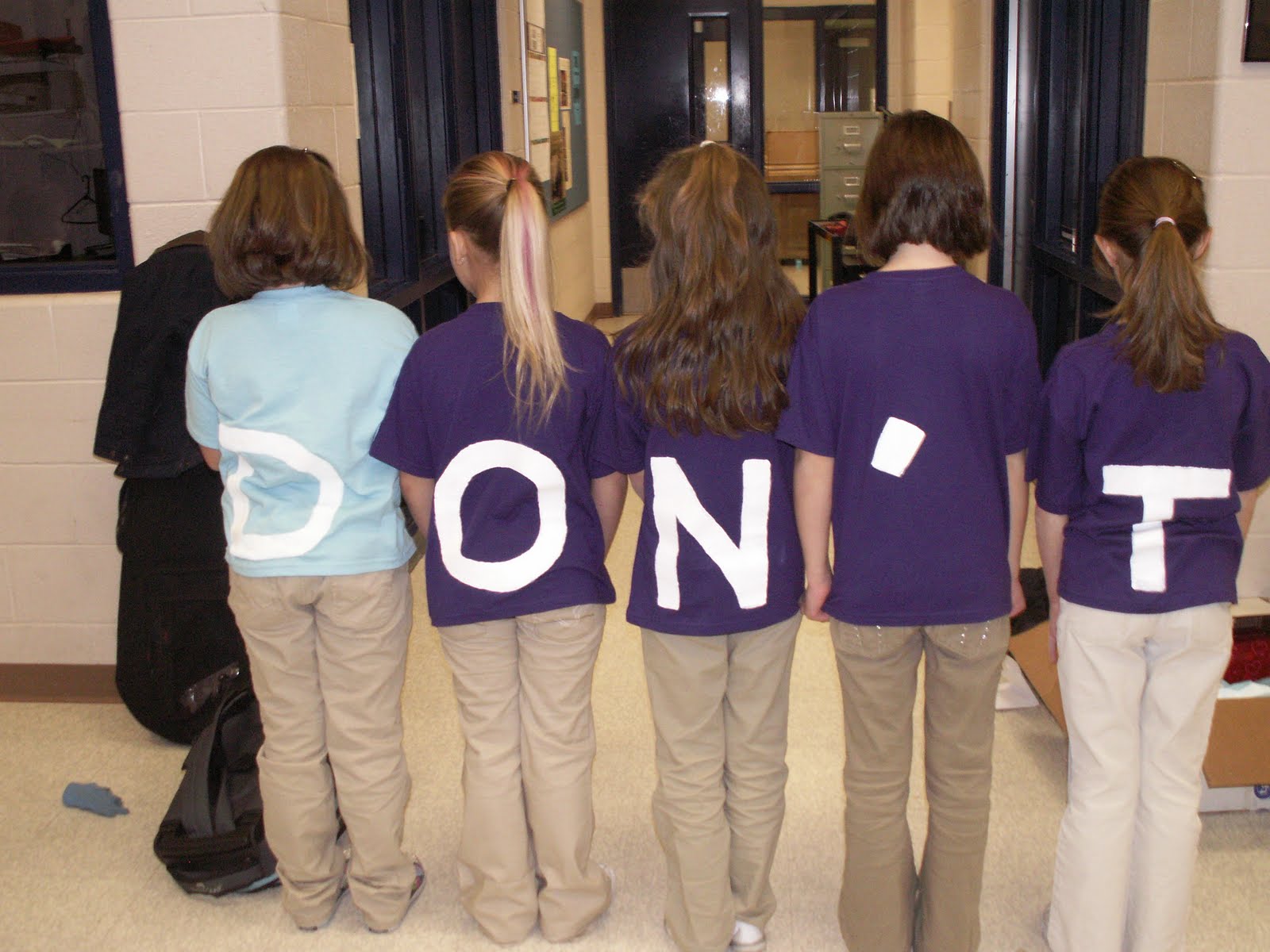
    5. We entered the Richmond Elementary School Talent Show and our act was designed to send a message to the audience about bullying. We danced to the theme song from the Movie Bugsy Malone…”You give a little love and it all comes back to you…you’re gonna be remembered for the things that you say and do….” Other cool lyrics included…”we’re weaker divided, good friends do tend to make you smile,” “shake an open hand, maybe trusting if you try to understand,” etc. During the dance the girls tossed beach balls out to the crowd to pass around that had your web site on them, a message about bullying and a cool lyric from the song. At the end of the song all the girls were lined up with their backs to the audience and the letters on their backs spelled out…don’t bully be kind! We were also able to get a message about bullying out to the audience through the announcer (principle) and the Talent Show program.

    6. The girls wore t-shirts in the talent show that said…”You’re Gonna Be Remembered for the things you say and Do” on the front. They are now able to wear them to school and tell people what it is all about.


    Thanks for letting me share! Pictures are soon to follow… from the Talent Show too!


    PS: I learned about your web site from watching ELLEN. I have sent her all of the above information as well as a few gifts from the Troop as well!!!

    Tuesday, February 8, 2011

    RESPECT, By Will S. Bunin

    Special thanks to Will S. Bunin for allowing PACER to post this poem. When asked about his inspiration, Will shared the following:

    This poem is stating that even if your bullied you can stand up to the bully, and never be bullied again. What inspired me to write this poem? I could say that it was the kind gesture of watching someone help another being bullied. I could say that it was me who saved another. I could even say that it was me who was saved by another, but all these things that I could say would be lies. They would be simple hopes that are not true. When I was younger, I was bullied. I was bullied for being weird, incompetent, and just plain different. I acted how I wanted to, and paid the price for it. This continued until I finally had enough of it, and stood up for myself. I wish I was able to say that someone stood up to the bully and helped me out, but this is not the case.

    RESPECT
    Will S. Bunin

    You don’t know me
    So don’t judge what you can't see
    Don’t smudge me out
    Don’t begrudge my Intel
    Just don’t hold a grudge
    Against my style
    Of all black
    Or hate the idea
    of a keychain
    on the front of my back

    Don't belittle what's different
    About this kid
    Don’t whittle my soul
    Down to its core
    Because that’s what bullies are for
    That’s what you 're doing to my life
    So don’t just stab me in the back
    With a rugged old knife
    This is not some surgery
    So stop being the jury
    And stop your misery
    Stop your condescending low heartedness
    You gruesome crow

    You might make fun of me
    Or ask me to calm down,
    But no!

    I'm not going to calm down for one second
    I'm going to simply stand
    Tall and fight

    I'm going to stand tall and fight you
    And your mean ugly hand
    Your cold moribund fingers that tremble
    Your dastardly deeds that correspond to evil
    You and your outright impurity,
    your cold, sickly, disorienting, repulsiveness
    That fills all with hatred hotter than bloods thick core

    I'm going to fight you because I can
    Because someone as ghostly as you
    Someone who causes as much hate as you
    Someone who is as unjust and relentlessly cold as you
    Needs to be stopped

    Who am I you ask

    I am simply him
    I am the one you bully
    I am the one you torment
    I am the one who needs help,
    But does not get it
    I am the one who looks toward a new horizon
    A new place of freedom

    I am me
    It's just that simple
    am the one who has had enough of your bad behavior
    I am the one who is standing up to people like you
    I am the one who WILL win against your soaring ways,
    Your bitter travesties.
    I am the one who shows respect to those who show me the same courtesy

    You want respect, don’t you?
    All people do

    If you want respect so much, then show me the same behavior
    If you want respect so much, then show him the same behavior
    If you want respect so much, then show everyone that you deserve it

    Don’t judge someone because they're weird
    Don’t judge someone cause they're annoying
    Don’t judge some because they're different
    Just don’t judge

    RESPECT.

    Thursday, February 3, 2011

    Peer Advocacy - Innovative Bullying Prevention Initiative


    The following is an article posted in local Minneapolis newspapers.

    Ten Watertown-Mayer Middle School students recently traveled to the Minneapolis Convention Center to share their innovative bullying prevention initiative with school board members and administrators at the Minnesota School Board Association Conference. The students presented to a standing-room-only crowd.

    The initiative, called “PACER’s Peer Advocacy Program,” is a collaborative effort of PACER Center and Watertown Mayer Middle School. Julie Hertzog, a Watertown parent of a student with a disability and the director of PACER’s National Bullying Prevention Center in Minneapolis, Minn., was concerned that her son might be vulnerable to bullying behavior. Because of that concern, she approached Connie Irvine, his middle school special education teacher, to discuss the issue.

    Hertzog, along with Irvine, and Cris Leinendecker, Watertown-Mayer school psychologist, set out to design a creative solution. What resulted is being hailed as an innovative game changer for school districts looking to improve the climate of their schools, especially with regard to bullying. “The Peer Advocate Initiative is the first of its kind, and Watertown-Mayer Middle School has done a fantastic job of developing and piloting it.”, Hertzog said.

    The premise of PACER’s Peer Advocate initiative is that the peers of children with disabilities become friends and advocates of these children. Students without disabilities are paired with students with disabilities, and receive training about the specific disabilities of their fellow students and how to advocate for them. These advocates spend time with Irvine and Leinedecker on a regular basis to discuss issues specific to their peer with disabilities and how to handle the issues. They also are anonymous reporters of bully behavior. The peer advocates plan fun activities specifically designed for their peer student, fostering friendships and relationships which normally would not be easily developed between typical children and those with disabilities.

    “The overwhelming consensus is that everyone wins,” Irvine said. “What began as a way to ensure the safety of a vulnerable child in a school setting has grown into a program that builds character and compassion.” The program also gives students the skills to stand for themselves and others in the difficult situations, Leinendecker said.

    The peer advocates report that this experience has changed the way they view those different than themselves, and has helped them to recognize everyone’s worth. “Some peer advocates have even admitted that they used to participate in bullying behavior, but because of this experience, they’ve stopped,” Irvine said.

    The program has been well received by the student body, and Irvine has been approached by other students wanting to get involved and become peer advocates. “Much of the success of this program is due to the commitment of Ms. Irvine,” Hertzog said. “She is the organizer, teacher, day–to-day problem solver and heart of the program. Without her selfless effort, the vitality of the program would not be nearly as strong. “